←back to hardware & design2025/Designed for the West Coast Swing scene
The name display that tells the floor who is playing.
→New DJ on the decks, ten seconds to swap
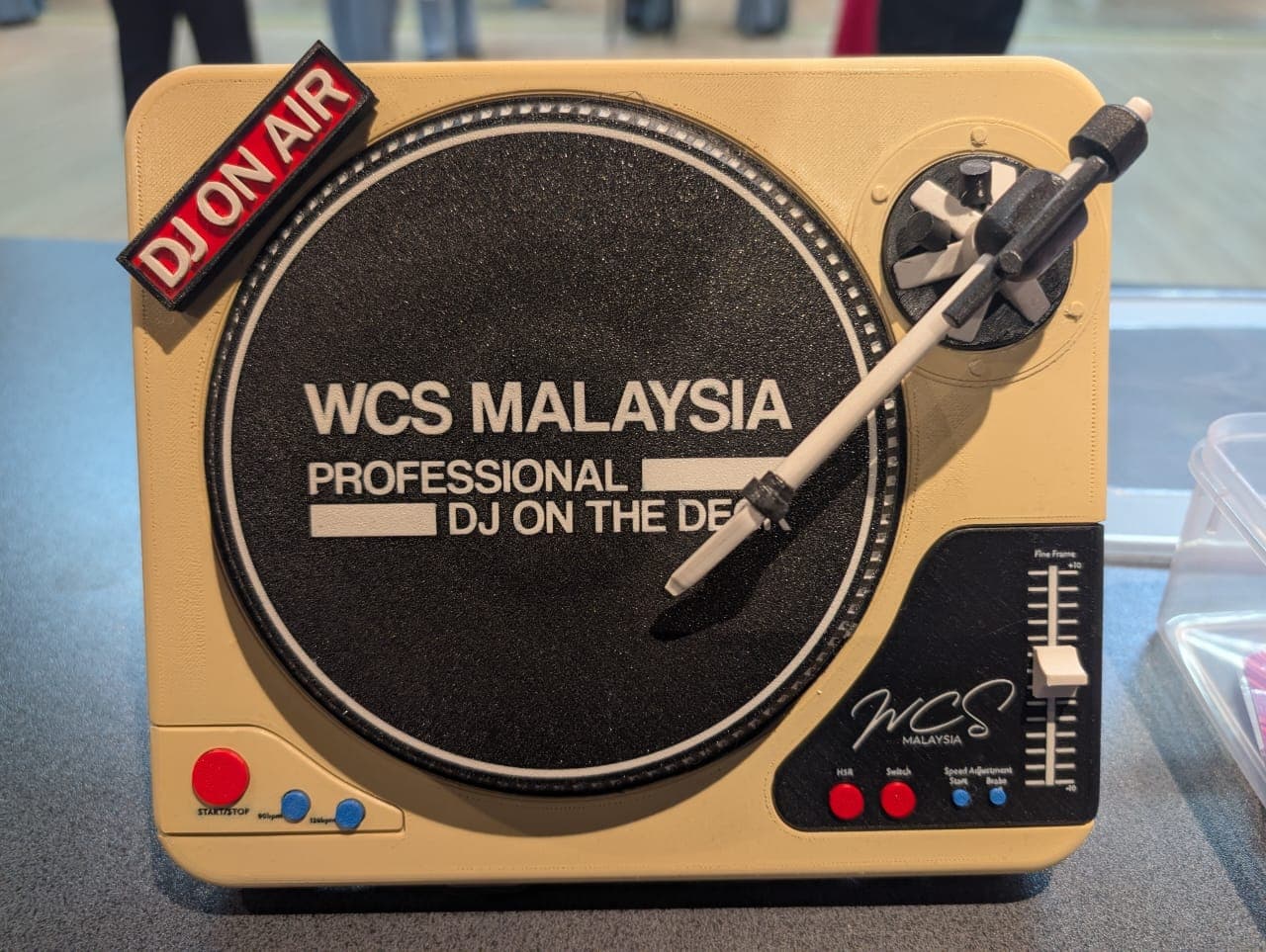
At a social dance nobody knows who is playing. The DJ is a person behind a laptop, and the only way to find out is to walk over and ask. This is a miniature turntable that sits on the table and answers the question, with a swappable record for every DJ in the scene.
A printed sheet of paper in a stand would have solved the information problem. It would not have solved the recognition one, which is the part that actually matters to someone who has spent the night reading a floor. So it became an object instead: a scaled-down turntable, modelled from scratch, that lives on the DJ table and carries the current DJ's name on a record you can swap out. It had to survive a bag, a dozen venues and being handled by strangers all night, and still look deliberate a year later.
I dance West Coast Swing, so this one started as my own irritation rather than a brief. Nobody sets out to design a name plate. I set out to stop walking over to the laptop to ask.
Designed for
One booth, every DJ
The record is the identity, and the record comes off. Every DJ in the scene gets a printed disc with their own name and artwork; a guest who turns up unannounced gets the blank one. Swapping takes about ten seconds and no tools. The booth itself never changes, which is the only reason it is worth building properly.
Built to be repaired, not replaced
It lives in a bag, moves between venues and gets handled by dozens of people a night. So it is printed in separate parts that assemble mechanically instead of one fragile piece held together with glue. When the tonearm snaps, and the tonearm is always what snaps, you reprint that one part in an hour rather than starting again.
Good enough to leave out on the table
Signage at a social dance usually looks like signage: a sheet of paper in a plastic stand. This reads as an object instead. Cream and black, a raked deck, a pitch fader that looks like it does something, and a DJ ON AIR flag standing off the corner. It earns the space it takes up.
How it was made
Onshape
Modelled from scratch, no kit and no downloaded base. Onshape handled the parametric side: platter and spindle fit, how the disc is retained, the stand geometry, and the tolerances that decide whether a printed part clicks into place or has to be forced.
Blender
Blender took the parts that are about how it looks rather than how it fits. Surface detailing, the artwork faces, and checking the whole composition before committing hours of print time to it.
3D printing
Printed, assembled, then revised against what actually happened in a room full of dancers: the angle it reads from across the floor, whether a stranger could swap a disc without being shown how, and which parts got knocked first.
More notes on the revisions to come. This write-up is a first pass.