←back to hardware & design2022/Product Design Engineer, Expedio Design
From a brief to something you can hold.
→Four products, brief to working prototype
Expedio Design is a small design consultancy firm, whose job was to turn startup product ideas into reality. As a product design engineer, I was the person in the middle, with clients on one side and manufacturers on the other. Indoor hydroponics for Ripefresh, movable furniture and in-built device holders for furniture makers, a powered tapping machine for rubber plantations, and a modular drawer system.
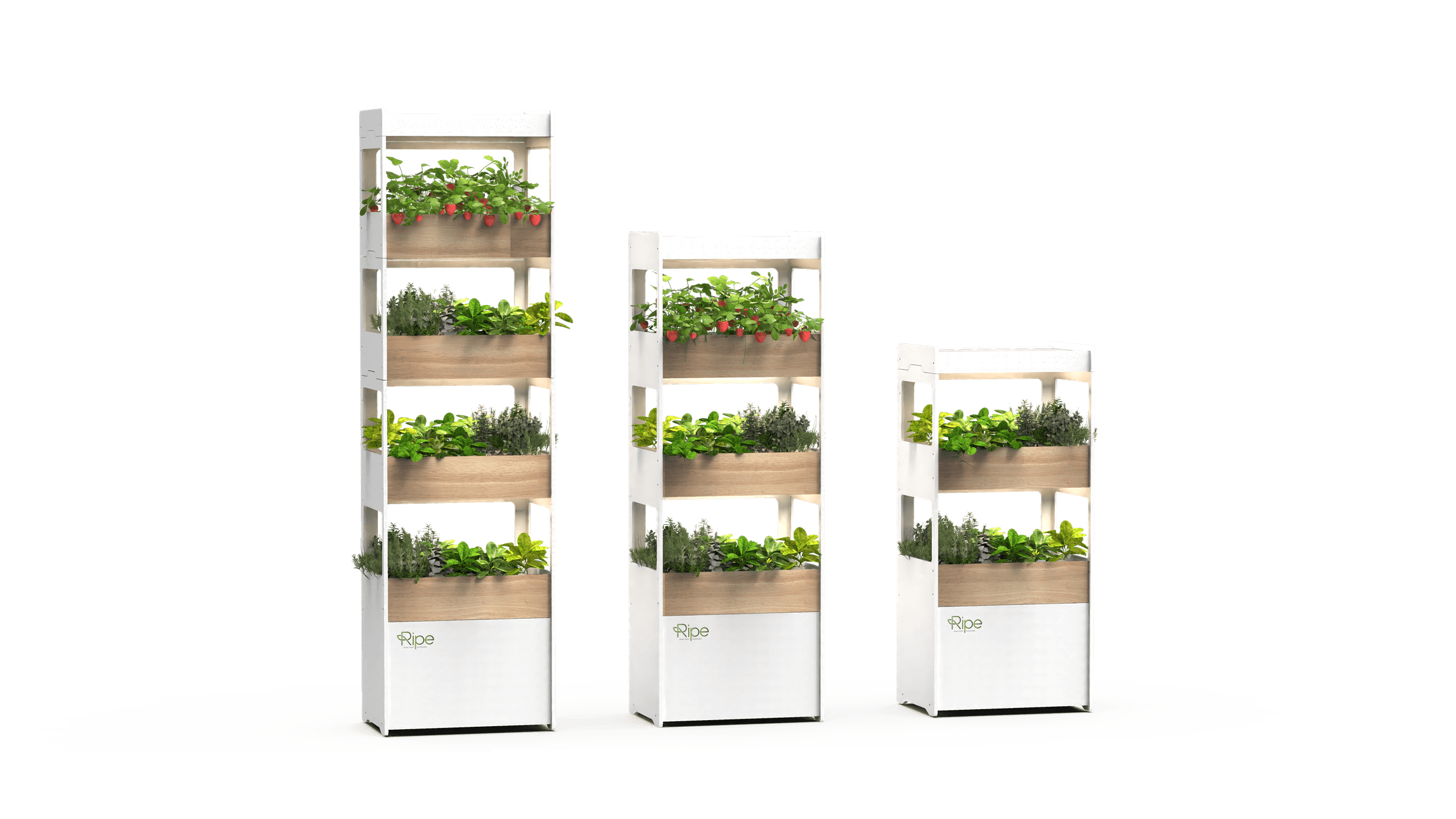
Ripefresh, designed as one family across three heights.
Each engagement required a unique approach, drawing on different skillsets and disciplines to solve. I ran three product engagements at once, balancing multiple demands. Clients describe what they want in outcomes. Industrial designers work in form. Manufacturers care about tooling, tolerance and unit cost, and will tell you what they think of your idea in about four seconds. Holding all three at once is the actual job. The design that survives is the one that satisfies everyone, and you find it early by asking the awkward questions before anyone has fallen in love with a rendering.
The work
Consumer indoor hydroponics
A hydroponics brand with a product people were meant to put in their living room, and a design language that still said laboratory. They also wanted a range, not a single unit, without paying to tool up three separate products.
What I did
- Developed the range as one product family across three heights, built from a shared set of parts instead of three designs that happen to look alike.
- Packaged the reservoir, pump, lighting arm and growing tiers into a cabinet that reads as furniture from the front and stays serviceable from the back.
- Took the benchtop unit through to a working prototype: sheet metal chassis, timber-laminate facing, sealed reservoir drawer, eight grow pods.
Why it mattered
One shared part set across three sizes means the manufacturer tools up once and the brand gets three price points to sell. That decision was worth more than any styling choice on the sheet.
02Furniture manufacturers
Movable furniture and in-built device holders
Manufacturers who wanted to sell furniture that does something rather than furniture that sits there. The catch was that nobody was going to change the way their factory already builds a couch.
What I did
- Designed an articulated device holder that folds into the void inside a couch armrest, swings out to hold a phone or tablet, and sits flush when it is not in use.
- Worked the linkage geometry around the existing armrest frame, so the mechanism became an add-on rather than a redesign.
- Designed movable cabinet systems on castors with pull-out platforms, so one person can reconfigure a small room without lifting anything.
Why it mattered
The mechanism was never the hard part. Designing to what a factory can already do is the difference between a concept and a product they will actually quote.
Powered tapping machine
Tapping is repetitive work done tree by tree, before dawn, hundreds of times a shift. Cut depth decides both the day yield and how long the tree keeps producing, and the experienced tappers who get it right are getting harder to hire.
What I did
- Designed the body and grip of a handheld powered tapping machine, shaped to keep the wrist neutral through a motion repeated all morning.
- Packaged the motor, drive and cutting head into a shell that splits for assembly and service, with the head placed so the tool sets the cut depth rather than the operator feel.
- Benchmarked against the machines already on the market to work out what to keep, what to drop, and where the cost actually sat.
Why it mattered
A consistent cut protects the productive life of the tree, which is the asset the plantation really owns. Put the judgement in the tool and a new hire performs like an experienced tapper on day one.
Modular storage system
A storage system that had to start small and grow, without the customer buying a second product or the manufacturer stocking a second catalogue of parts.
What I did
- Reduced the system to a minimum part set: one post, one panel size, one connector, scaling from a single low unit to a full-height stack.
- Designed the corner joint so panels drop into an extruded post. It assembles without glue and comes apart again without damage.
- Kept every part flat-packable, so shipping cost scales with what sells rather than with air.
Why it mattered
Fewer unique parts means cheaper tooling, simpler inventory and flat-pack shipping. The customer buys the small one now and extends it later instead of replacing it.
How I work
I sit between the client and the factory
Clients describe outcomes. Designers work in form. Manufacturers care about tooling, tolerance and unit cost, and will tell you what they think of your idea in about four seconds. Holding all three at once is the job, which usually means asking the awkward question early rather than finding out at the quote stage.
I design to what can actually be made
Sheet metal, injection moulding, timber and laminate, off-the-shelf fasteners and bearings. If a detail cannot be manufactured at your volume and your price, it is not a design yet. It is a rendering.
You end up holding something
Every engagement here finished with something physical: a unit you can switch on, a mechanism you can fold in and out, a joint you can put together by hand. That is the point where a client can make a real decision instead of an imagined one.
Got a product that only exists as a sketch?
Tell me what it has to do and who has to manufacture it. I will tell you honestly whether it can be built the way you are imagining it, and what I would change if it cannot.